|
|
HOME ABOUT US EXHIBITIONS ART FAIR Artists PUBLICATIONS INVENTORY THE GUILD ART JOURNAL NEWS CONVERSATIONS |
|
Navjot Altaf |
|
|
|
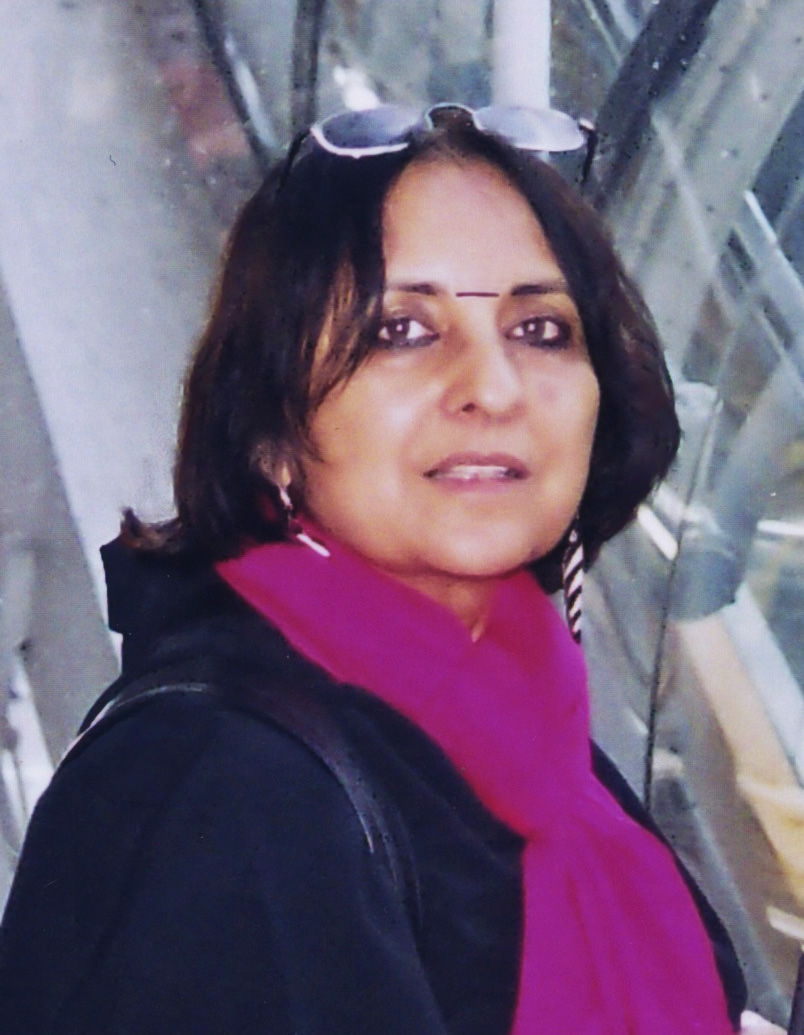
Born 1949 in Meerut (U.P), Navjot Altaf studied fine and applied arts at the Sir J. J. School of Arts, Mumbai and graphics at the Garhi Studios, New Delhi. Working across mediums, she has been using video since 1994, and is considered one of India's earliest video artists. Navjot Altaf is one of the most profound and significant contemporary Artist of her times. She was invited for 'ZONES OF CONTACT' Sydney Biennale, 2006. Her other recent participation/projects include; Arte Fiera 2009, Bologna, Public Places Private Spaces at Newark Museum, New York; Tiger by the Tail, Women Artists Transforming Culture at Brandies University/Museum Boston; 'CONTINUITY AND TRANSFORMATION' Museum show, exhibition promoted by Provincia di Milano, Italy. 'Groundworks' Carnegie Mellon University, (RMG) Pittsburgh, U.S.A.; 'Another Passage To India ', Theatre Saint Gervais and Musee d’ Ethnographie, Geneva.Switzerland;'ZOOM –ART IN CONTEMPORARY INDIA', Edificia Sede de Caixo Garal de Depositos, Lisbon.; 'Century City’ - Bombay/Mumbai: City Politics and Visual Culture in the 90’s', Tate Modern London, U.K.; 'subTerrain' Indian Contemporary Art, House Of World Culture, Berlin. Solo exhibitions include - 'Jagar' Multimedia Installation, Sakshi Gallery Mumbai, India;' Water Weaving', video Installation,Talwar Gallery, New York, U.S.A.;'JUNCTIONS 1 2 3' at The Guild, Mumbai. Navjot oriented away from the individualistic, but towards collective endeavors, in much of her works she has given prominence to people’s testimonies of social violence. Her work on projects with students and women has always been a part of a wider concern on social and educational issues, through which she has sought alternative art practices and communication outside the gallery space. The question of description haunt the reception of her work, as she has been associated with varied fields, being an Artist, a Researcher, an Anthropologist, a Social Worker and a Political Activist. “Altaf has consistently sought to problematize her own position as an urban, non-Adivasi artist in her work at Kopabeda. In fact, the process of acknowledging and negotiating differences (of class, gender, culture, and caste) has been a central part of her creative praxis over the past ten years. Altaf, Rajkumar, Shantibai and Ghessuram have developed a set of performative protocols to guide the decision-making processes necessary to work together creatively. Altaf, for her part, has refused to take up the position of nomadic agent of critique so popular in the mainstream art world (the artist/provocateur who briefly appears at a given site, stages an “intervention,” and then departs). Nor would she claim to speak with any absolute authority on behalf of Adivasi or peasant experience. Both positions effectively bypass the question of ethics; the first by claiming a capacity for ironic detachment or distanciation that is assumed, by it’s intrinsically transgressive nature, to render such questions irrelevant, and the second by assuming a natural coincidence between the artist’s interests and those of her collaborators. And both positions are equally naïve. Altaf has taken a third path, occupying neither the mythical “inside” of the organic intellectual, nor the equally mythic position of the (transcendent) outsider bearing the Promethean gift of critical insight” - Grant Kesser on Navjot Altaf and her Collaborative Praxis in an Adivasi Villages. Since the early nineties, Navjot has been involved in interactive, co-operative and collaborative projects with Indian and International Artists, Classical Vocalists, Documentary Filmmakers, Activists, Craftsperson’s and Technicians. Since 1999, she has also been engaged with ongoing site-oriented art projects with tribal artists from Bastar, Chattisgarh in Central India. “Navjot has clearly re-tracked the familiar terrain of social injustice and violence, transmuting her concerns to the intimate, often hidden private lives of women. These works are clearly about the language of eroticism, of the male gaze that still relegates women to sexual object, of hollow, unfulfilled lives and of female sexuality as the site of as much pain as pleasure. This in turn lends itself well to the pictorial convention of communicating the complex thinking and emotion inherent in the feminine predicament the subject of carvings. And to testing the limits of making pathos manifest. In this balance struck between the work as empathic representation and as autonomous formal creation, lies the essence of its expression.” – Geeta Kapoor. |
|
||
 |
|||
 |
|||
 |
|||
 |
|||
 |
|||
© 2002 The Guild. All rights reserved.