|
|
HOME ABOUT US EXHIBITIONS ART FAIR Artists PUBLICATIONS INVENTORY THE GUILD ART JOURNAL NEWS CONVERSATIONS |
|
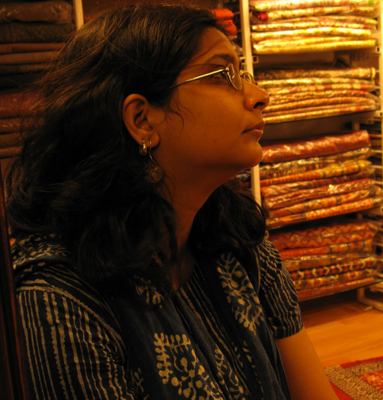
Lavanya Mani |
|
|
|
Born in 1977,
Lavanya Mani started Ph.D in 2001 from the Dept. of Art History &
Aesthetics M.S.U. Baroda, under Dr. Shivaji Pannikar. She pursued MFA in
Painting (1999-2001) and B FA in Painting (1995-1999), from The Faculty
of Fine Arts, M.S.U Baroda. Lavanya
Mani has participated in Group Shows in Paris, Hyderabad and Baroda. In
2006 she was recipient of KAVA (Kashi Award
for Visual Art) Kashi Art Galley, Kochi and in 2001 the Nasreen
Mohammedi, Award for Painting, Faculty of Fine Arts MSU Baroda. Her
recent group participations are: in
2009, Analytical engine at
Gallery Seven, Delhi, in 2008: Through a Glass, Darkly at the Guild,
Mumbai and Interlude: Venice/Kassel at N.C.P.A by The Guild, Mumbai.
Lavanya Mani is one of the
new age women artists in India, who skillfully negotiates the postmodern
dilemmas in her works. Addressing a much debated colonial history from
an elevated field of multi-cultural give and takes, Lavanya Mani finds
her language from history, book illustrations and pictorial renditions
of the moral stories. Over the last few years, Lavanya has been working
with various techniques associated with textiles such as embroidery, tie
and dye, appliqué, batik etc in conjunction with painting. She talks
about her works saying that, “Cloth has been at the center of a long set
of historical associations between femininity, decorativeness and
deception. These have to do, on the one hand, with the way various art /
craft practices such as embroidery, knitting, needlework etc, were seen
primarily as “women’s work”, as well as to the perceived sinfulness/
excess of the decorative, within a patriarchal economy, that privileged
austerity and functionality. This could also be related to what was
considered to be the inherent deceptiveness of cloth- as its ability to
hide as well as reveal, and its ability to change the persona of the
wearer; tales and fables, that have been associated with it, emphasize
dyeing and changing colors as a narrative device.” – Lavanya Mani.
“Anyone
who comes across the works of Lavanya Mani can comfort himself with a
partial stake over the images that populate her works. They belong to
the family of Imperial imagination, with visions, which wonder, amuse
and haunt the subjects of the Empire. We all know a little about our
colonial past, and we all have gone through the same feelings of
amusement and disbelief leafing through the pages of occidental accounts
of oriental histories. The narrations perhaps have the most appeal when
we stumble upon words and images that displace our image of ourselves.
They create that uneasy euphoria which we reserve for the ignorant
master whose knowledge of our world is always abstract and far from
reality. Lavanya’s works deal with such images of abstraction. They make
room into the crowded Colonial Archive, pry open its doors and invite us
to have a walk around. Lavanya does not aim to see her work as the
logical conclusion of a historical process. Her attitude to the history
of representation is at best navigational, and her artistic process is
closer to commentary than interpretation. Her images rather precede her
chosen genealogy, reversing the route of disseminations, and as a result
she helps us see the past without suspending us from the present. It is
this projective quality that makes her work so interesting; they work as
independent supplements to the already existing archive of the Empire.”
– Parvez Kabir. |
|
||
'&des='Natural+dye,+chemical+dye,+acrylic+and+applique+on+cotton+fabric'&folder=Images/LavanyaMani/LM-14.jpg&freight=3500&price=00) |
|||
 |
|||
© 2002 The Guild. All rights reserved.