|
|
|
|
|
|
|||||
|
sunil das |
|||||||
|
|
He
was born in Calcutta, West Bengal. ? 1955-66 He joined weavers service
centre office of the Handloom Ministry of Textile Govt. of India. ? 1960
Founder member of the Society of Contemporary Artists, Calcutta. ? 1963
Member de la Societe des Muses Nationale d` Art Moderne, Paris. ? During his
Govt. service he worked with Mrs. Pupule Jayakar. ? 1979 Elected Member of
Purchase Committee for National Art Exhb. and Miniature Format Exhb., also
for sculptor exhb. ? 1980 Joint Secretary of Contemporary Artist, Calcutta.
? 1981 Invited as Jury for Hyderabad State Akademi, Hyderabad. ? 1982
Committee member of 5th Triennale India. ? 1982 Elected jury member for
National Exhb. of Art, Lalit Kala Akademi, New Delhi. Member of the General
Council, Lalit Kala Akademi, New Delhi. Lives and works in Kolkata. "To
prevent myself from producing the same kind of work, I keep altering my
vision. From the day people begun to see me as a painter, a huge
responsibility fell upon me, particularly to respond to the feelings of the
people at the grassroots level who are also my viewer, as also to delve deep
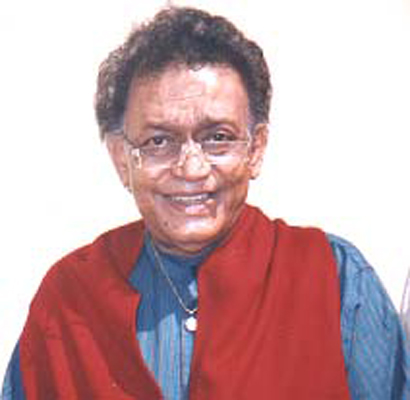
into realties of life around me." One of India's important post-modernist painters, Sunil Das rose to prominence with his drawing of horses. "I must have done 7000 horses between 1950 to 60," he says. "In 1962, I went to Spain, where I was fascinated by the bull fights." About 60 years of age, he can look back at his nine to ten phases of paintings, all of them marked by supreme skill and a sense of integrity. An indefatigable painter, Das jumped from one style to another easily. Talking about his art style, he says, "To express my authentic feelings about reality, I have to interpret it, I have conceptualize it. The previous reality gets transformed in the laboratory of minds. Then, I bring it out on the canvas." Das
came from a middle class family and his father was just a small businessman.
After completing school, he decided to become a painter and joined a local
art school. "I am a good sports man," he says. "I like things
which have a lot of rhythm and energy." He doesn't ever use photographs
or models for his painting. "I do a sketch before I start painting. I
always struggle with colours and shapes, until they fall to desired pattern.
Like a music conductor, I summon all my music instruments to play and
orchestrate an aesthetic unit out of various experiences." He does not
confine himself to using brush or pen while painting, and often paints with
the palms of his hands or with his fingers. A French art scholarship with the Ecole Nationale Superieure des Beaux-Arts took him to Europe. It was in the course of his travels that he chanced to spend a few months in Spain, where he developed his passion for horses and bulls. Das' paintings have also been influenced by his study of sculpture at Santiniketan, Kolkata, and his study of graphic art in Paris. His paintings have a kind of structure and rigidity that one would typically find in sculpture and in the etchings of graphic art. Das's paintings not only express the physical attributes of his subjects but also their associative ones. Every once in a while he paints human beings, but his depiction of the human anatomy is skewed, to a point that it almost borders on macabre surrealism. For example, his series on women with mysterious, tantalizing eyes - all oil on canvas, the portraits convey, in various forms including the erotic, the pressures women are subject to. Hardly ever painting in loud or warm colors, Das uses soft brown, mauve and white in the background to bring out the drama of life. He blends talent with hard work. He works by suggestion and minimalism. Quite absurd in form, his paintings are morbidly fascinating. "I delve a lot on man's inhumanity to man," he says. Das has the distinction of being the only Indian artist to have won a National Award (the Shiromani Kala Puraskar) while still an undergraduate at the Government College of Art and Craft, kolkata. Besides having been featured in several exhibitions, his works are also a part of the collections of renowned museums such as the National Gallery of Modern Art, New Delhi, the Glenbarra Art Museum, Japan, and the Ludwig Museum, Germany |
© 2002 The Guild. All rights reserved.