|
|
|
krishen khanna |
|||||
|
|
|||||
|
|
|||||
|
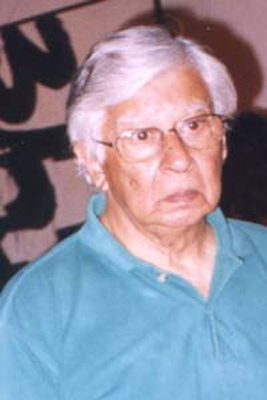
Born in Lahore in 1925, Khanna learnt the tools of his trade at the evening classes conducted at the Mayo School of Art, Lahore. In the wake of India's partition he moved to Simla and thereafter to Delhi where he currently lives and works. So far, he has had over forty one-man shows held at galleries in India and abroad. He has participated in the Tokyo Biennale, in 1957 and 1961, the Sao Paulo Biennale (1960) and in the Venice Biennale (1962). He won the National Award of the Lalit Kala Akademi, New Delhi in 1965, the Gold Medal at the First Triennial of Contemporary World Art, New Delhi in 1968. He was a recipient of Padma Shree, awarded by the President of India, in 1996. Khanna was awarded the Rockefeller Fellowship in 1962 and was Artist in Residence at the American University in Washington in 1963-64. Apart from several one man shows he has participated in group shows like the Tokyo Biennale 1957 and 196 1, the Sao Paulo Biennale 1960, the Venice Biennale 1962, the Festival of India in the then USSR and in Japan in 1987 and 19 88. Khanna has held several important positions in decision-making bodies of the Lalit Kala Akademi, National Gallery of Modem Art and Roopanker Museum, Bhopal. Khanna transfers his observations onto the canvas, with spontaneity and exuberance, without obliterating his subject matter. His earlier works are reproductions of scenes that have imprinted themselves on his mind. He was profoundly moved by the events he witnessed during the Partition of India in 1947. He painted 'News of Gandhiji's Death' after the Mahatma's assassination, which shows a group of people standing motionless around a traffic island in Delhi, all immersed in their newspapers. Making a gestural impact on the canvas Khanna's masterful deployment of paint to evoke the human situation is unmatched. The thick impasto surface often seems like a prism through which figures can be discerned as if in memory or in remote areas of childhood. Khanna lives and works in New Delhi. "They call it drawing. I really have no name for it. It's a compulsion, an itch. It is enjoyable but it can also hurt when nothing emerges but an incomprehensible mess." These are the words Krishen Khanna uses to describe his art. Khanna does not favour the profusion of figuration, common in Indian paintings.
© 2002 The Guild. All rights reserved. |
 |
 |
|||
 |
|||||