|
|
HOME ABOUT US EXHIBITIONS ART FAIRS Artists PUBLICATIONS INVENTORY THE GUILD ART JOURNAL NEWS CONVERSATIONS |
|
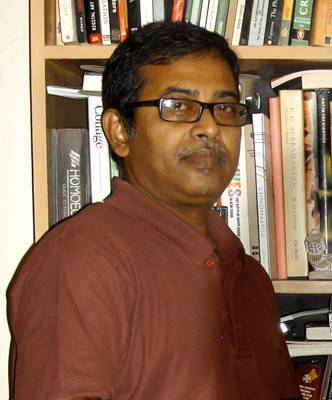
Baiju Parthan |
|
|
|
Born in Kerala in 1956, Baiju Parthan is
considered to be an important new media art pioneer within the Indian
contemporary art context. He successfully exhibited his first – and the
first o fits kind in India- interactive digital installation ‘ Brahma’s
Homepage’ in Mumbai in1999.He was also instrumental in contributing to
the new visual language of Indian Contemporary art as one of the core
figures who laid the foundation of ‘Mediatic Realism’ in painting. Baiju
Parthan holds academic degrees in Botany, Painting, Comparative
Mythology studies, and Philosophy. He has exhibited at various venues
both national and International.
“Baiju Parthan’s art practice revolves around information
technology and its impact on perception and meaning generation. His art
explores how information streams alter our perception of reality and how
new categories of experience clubbed under the generic term 'virtual'
reshape our cherished ideas about the world. Technology in his work is
primarily used as an interactive space’, where each node is a choice
that branches out into an exploration of fluid boundaries of meaning,
that suggests the ever present local within the global, and the human
cogency. The mediums
of his works are a commingling of his training in various fields. He at
one makes paintings, digital images, installations, as well as translits
or backlit display boxes.
He makes
sophisticated play with the seductive images & slogan – wisdom of
advertising & the media & at the same time he incorporates elements from
popular religious iconography in his dream constructs, as he sometimes
describes his artworks. Personally, he lives in a post-colonial concept
of space where the world exists as a flux. Entering the domain of Baiju
Parthan’s images is rather like entering a computer game, an experience
of revelry in which you are dazzled by mysterious symbols, set afloat on
a stream of cross references, stonewalled by coded instructions and
rescued by escape routes that open up without warning.
In this regime of
metamorphosis, forms change constantly, but certain hereditary patterns
retain their force: garnering their energy from a polyphonic
simultaneity of ancient and contemporary mythologies. He is entirely in
synchrony with the underground history of out age, which is being shaped
by dissident global movements of pacific anarchism, environmental
awareness and spiritual regeneration in the catacombs and cathedrals of
the Net. Parthan’s images attest to the swirling and chaotic ancestries
we carry within us and they are a riddling collage of images and text
that appeals to the sensuous apprehension even as it stimulates the
intellect.” – Ranjit Hoskote.
Baiju in an
interview about his works: “I never really plan and execute works. What
is around me comes into my paintings. I have been creating works about
globalization as a homogenization process. Though I've begun to explore
political material in my work, I'm not taking an activist standpoint.
First an image strikes me. I believe that certain images or motifs have
an intensity that is apprehended on three levels, First physically
(which is to say visually), then emotionally and then intellectually.
There is an incubation period, when the image gathers elements, and
creates its own pictorial space. And then there is the process of
transformation, which is the process of painting. I try to actualize my
mental vision of a painting, but more important than the details is to
capture the picture's intensity. If I succeed at this, I am happy." |
|
||
+2',+2010&code=Baiju+Parthan&artist='Baiju+Parthan'&dimen='23+x+66+inches+edition+of+6'&des='Archival+print+on+Hahnemeuhle+fine+art+pearl+paper'&folder=Images/BaijuParthan/BP-81.jpg&freight=3500&price=00) |
|||
 |
|||
© 2002 The Guild. All rights reserved.